Showing posts with label City Reports. Show all posts

Sunday, June 9, 2013

The Future of Transportation in New York City


Throughout the world, cities will advance their transportation networks as technology rapidly advances.  New York City, perhaps, will advance their transportation network quicker than most.  Envision a day when all cars in New York City are equipped with GPS tracking units.  These GPS units will monitor parking and other traffic violations.  Essentially this technology could wipe out a fraction of the police force and save the city money. 

GPS Tracking Device, credit: GPS Device Reviews

Monday, June 3, 2013

Travel Demand Management for London Olympics 2012


The London Congestion Charge was not the only travel demand management tool employed by Transport for London during the Olympics in 2012. This post looks into some of  measures taken by TfL to manage travel demand during the Games.

With an estimated 20 million visitors expected to attend the Olympic and Paralympic Games the transport network was poised to experience “substantial increases” in travel demand, says Rose McArthur, SKM Practice Leader in sustainable travel ‘with extensive experience in developing strategies to improve travel choices. London 2012 and the Transport for London (TfL) had deemed the 2012 Games as the first ‘public transport Games’, meaning that, “100 percent of visitors were asked to travel to the Games on public transport, by bicycle or on foot”. It was noted that on the busiest day some 800,000 spectators opted for public transport, resulting in approximately 3 million surplus trips. In such a scenario, travel demand management was critical to ensure the smooth operation of transportation and all those affected by London’s transport system and the Games.  

Controversial road pricing in Denver: drawbacks of public-private partnerships

Like many state and local governments, Denver and the state of Colorado have realized that the demand for new taxes falls short of demand for new roads.  In light of revenue constraints, Colorado turned to the Federal Highway Administration’s Innovative Program Delivery unit to coordinate the eight member jurisdictions and a range of private investment firms, including the now defunct Lehman Brothers, to build the E-470 Tollway. The 47-mile road completes the eastern side of the beltway around the Denver region. The western end of the beltway never quite completed the loop, however, as environmental groups protested the proposed alignment that ran along a wildlife refuge and cut through open space reserves.  E-470, which runs through distant eastern exurbs of Denver and the wide open Colorado prairie, faced no such opposition.

Parking Policy

The bus rapid transit of Bogotá has been well known for its sustainable transportation system. However, the parking revolution has gotten little attention. Along with launching the Transmilenio Project, the parking reformation was  started to provide more public spaces for the people. Specifically, the main goal was to recover public spaces which were occupied by automobiles instead of people. It was also to take back public spaces which were taken up by vendors, street hawkers, and other private users to public space users including pedestrians. Peñalosa, a former mayor during 1998-2000 when various innovative people-centric transportation policies were implemented, refuted the idea that users of parking facilities, such as car drivers and shopping mall owners, need to supply their parking places  for public use, and argued that it is not necessary to accommodate their private needs through public assets. He commented once  "Does the city give me a public closet to put my shoes inside? No, then they shouldn't give me a parking space to park my car." Although most of the citizens favored the new parking policy where on-street parking places were transformed into wide sidewalks, it was really hard to implement because of opposition from neighboring communities and retailers. The mayor was almost impeached due to this policy. On-street parking reforms turned out to be successful. On-street parking places had been replaced by off-street parking lots. Tax subsidies to private retailers or companies who built off-street parking facilities aided in the success.


(Resources)
1. Arturo Ardila and Gerhard Menckhoff,2002. "Transportation policies in Bogota, Colombia: building a transportation system for the people” ,Transportation Research Record 1817, 2002.

2. Carlosfelipe Pardo , "Parking revolution in Bogota: The Golden Era, 1998-2000", October, 2010. Web.


Congestion Pricing in Bogotá


                There has been some movement in the direction toward congestion pricing in Bogotá (and in all of Latin America) but the implementation of it has been difficult and is met with a great deal of opposition.

Sunday, June 2, 2013

From SigAlerts to Tanker Fires: How Caltrans Manages Los Angeles Freeways

Source: mochigames.com

Field Test Amsterdam

Praktijk Proef Amsterdam (PPA) translates to Field or Practice Test Amsterdam.  It is a coordinated network-wide traffic management and ITS project that began in the Amsterdam region by the Ministry of Infrastructure and the Environment in 2012 and will run through 2014, with final evaluation results to be

Saturday, June 1, 2013

Singapore: where an intelligent transportation system can work...

I was amazed by what Singapore has become today as one of the top global cities in Asia. It has one of the most extraordinary advanced transportation management system in the world. The Land transportation system (LTA) is using its best efforts to develop and control traffic through all Singapore.


Friday, May 31, 2013

Copenhagen’s Failed Congestion Charge

Copenhagen is a city known for its flourishing bike culture. However, as it is succeeding at getting more people biking to work, it is also struggling with increased auto use because of an increase in overall trips into Copenhagen from surrounding towns. In a past post we discussed ways Copenhagen has been dealing with bike congestion. We also touched on a Copenhagen’s investment in rail. In this post, I am going to discuss the rise and fall of Copenhagen’s congestion charge plans.

In 2004, London became the first major city to implement a congestion charge. How it works is that anyone who enters the ring that has been set around downtown in an automobile during the work week is required to pay a fee of 8 pounds for the day, which they can pay online. As of 2012, London’s congestion charge has been wildly successful. Congestion has dropped 30 percent and average driver speeds are at the highest level they have been in 50 years.

In 2006, the Forum of Municipalities (a grouping of 16 municipalities near Copenhagen) released a report studying the implementation of congestion pricing in the greater Copenhagen area. According to the Forum, the average speed of automobiles during rush hour was down to 20 kph. This resulted in more than 130,000 hours of wasted time, or the equivalent of about $1 billion in lost productivity. The Forum suggested implementing a congestion pricing schema to reduce or eliminate congestion and to invest the money earned from fees directly in public transit investment.

There are two ways to do congestion pricing. The first is similar to tolling. Users can either be charged to use uncongested lanes, or all users of the highways can be charged based on the current level of congestion. If a road was very congested, the price to use the road would increase. If the congestion level went down, the price would drop. The second way to do congestion pricing is to use the London model and set up a boundary around the downtown. This is what the Forum recommended. They propose a boundary be set up around Copenhagen’s center and that all those entering the center be charged a daily fee. They suggest charging 25 DKK ($4.35) during morning and evening rush hour, 10 DKK ($1.75) during the rest of the day, and having no charge for entering the city center in the night. The Forum believed congestion pricing could reduce congestion, increase productivity, better air quality, reduce noise pollution, and contribute to reducing climate change overall.

In 2011, a congestion charge in Copenhagen looked all but inevitable. Unfortunately, ministers in Denmark shot down the proposed congestion charge in 2012. Although politically will could change in the future, for now a congestion price in Copenhagen has been shelved.

Sources:


Edited by: Darwin M

Today You Don't Drive


Mexico City is one of several cities currently operating a license plate rationing strategy for transportation demand management. This has been predominantly a mechanism used in Latin American cities, including Bogota and Sao Paolo. License plate rationing is when access to certain areas--usually downtown cores--is restricted by the plate numbers on vehicles. For example, on Mondays cars with plates that end in a 5 or 6 cannot enter downtown. This policy is meant to primarily improve air quality, but also limit congestion and increase transit ridership. 

Tuesday, May 28, 2013

NYC Tries to Make Parking Smarter

NYC has notorious parking problems, and finding a spot can be very difficult.  This leads to plenty of illegal parking, and added congestion to NYC's already packed streets.  A study of one NYC neighborhood by Transportation Alternatives found that 1 in 6 cars were parked illegally, and over 50% of the street traffic was looking for a spot to park.  Transportation Commissioner Janette Sadik-Kahn's tenure has been marked with bold efforts to improve the function of city streets, including new solutions to persistent parking troubles.

Monday, May 20, 2013

Shifting Away from Automobilities


As we've covered previously, Mexico City has experienced dramatic change over the last five years to its transportation system. Long regarded as one of the worst commuter cities in the world, Mexico City has seen such growth that they received the 2012 Sustainable Transport Award from the Institute for Transportation and Development Policy (ITDP). This can be attributed to the city's system-wide shift away from automobility planning towards a multimodal approach emphasizing transit and active transportation options.

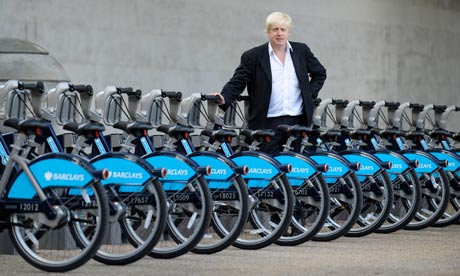
London: Barclays Cycle for Hire


London’s bicycle sharing scheme, Barclays Cycle Hire (BCH), scheme was introduced in 2010 by Mayor Boris Johnson and is touted as a catalyst for London’s cycling revolution. Barclays Bank funded a majority of the initial scheme, with operations fully funded by Transport for London. The scheme is often referred to as Boris Bikes after the Mayor and several community forums like this are fast gaining popularity. BCH gained instant success, with six million trips made in the first year alone, totaling almost 15 million trips since its inception and reaching a record high during the London Olympics in 2012. Although, Mayor Johnson is credited for the BCH scheme, it was actually first announced by the previous mayor, Ken Livingstone in 2007. The scheme drew inspiration from its European counterparts and is heavily modeled after the Velib, Paris’ bike share scheme.

Boris Bikes

Expanding Amsterdam’s Metro: Helpful or Headache?


Amsterdam’s bicycle infrastructure and culture are frequently touted, but what about it’s other modes of transportation? Since the 1970’s, Amsterdam has enacted a number of polices to discourage car use in the central city. In conjunction with these polices, Amsterdam has built a large and multi-modal public transportation network. The network includes an extensive bus system, sixteen tram lines, passenger and bicycle ferries, and the Metro, which consists of rapid transit and light rail lines.

Sunday, May 19, 2013

In Los Angeles, Every Lane is a Bike Lane

One of many Metro bus banners encouraging Los Angels to share the road[4]


In Los Angeles, cars clearly dominate the roads. However, in spirit of expanding and promoting cooperation with all users of the streets, Los Angeles Metro created the “Every Lane is a Bike Lane” (ELBL) campaign. Aimed primarily at automobile users, the push behind ELBL is to bring increased awareness to cycling “without showing cycling as reckless or dangerous.”[1]

Saturday, May 18, 2013

New York City Gears Up For the Launch of Citi Bike Share


Bike share will soon be unveiled after significant delays on Memorial Day for the “early-bird” types who purchased an annual membership in advance online.  The system will feature short-term and annual memberships, including one-day passes ($9.95) or week-pass ($25) for visitors. 

Woman riding a Citi Bike, credit: Crain's New York

The Ciclovia and Cicloruta Programs in Bogotá


There have been major investments in pedestrian and bicycle infrastructure in Bogotá, mostly started during Mayor Peñalosa’s term in office. Two of the programs specifically designed for bicycles are the Ciclovia and the Cicloruta.

Monday, May 13, 2013

East Midtown Rezoning Study: New York City Revisits the Ultimate TOD


Grand Central Terminal

Grand Central Terminal is one of New York's historic landmarks and a major transportation nexus, serving over half a million people each day.  The access provided by Grand Central Terminal helped grow the East Midtown area into one of the largest job centers in NYC.  East Midtown contains 70 million square feet of office space and 200,000 workers, as well as many of the City's iconic buildings and landmarks.

East Midtown Rezoning Area

The City is in the process of two new major transit projects that will bring even more commuters through Grand Central.  To complement the new transportation infrastructure, the City has proposed a dramatic plan to reshape zoning in East Midtown.  The plan creates a streamlined zoning process that will fund a dedicated pedestrian improvement program, encourage higher densities, and promote the creation of new iconic environmentally sustainable buildings.  It may not be Transit Oriented Development in the strictest sense, the plan is the City's latest effort to make sure transit and development are harmonious and mutually reinforcing.

Crossrail Shapes the Future of Transit Oriented Development in London


London seemed to take stock of itself in 2000 and 2001 regarding growth and planning with the creation of the Transport for London and the production of the Urban White Paper. The former is the governmental agency in charge of all transportation aspects of Greater London. The later is the document or report calling for, “better design in cities and the provision of affordable homes”. Both serve as guides for dealing with the projected growth London will encounter in the future.

Sunday, May 12, 2013

TOD in Los Angeles: A New Wave of Thinking or Auto Oriented Development?

             Casden West Los Angeles is a proposed large-scale transit-oriented development (TOD) to be constructed near the planned Expo Line in the heart of West Los Angeles. The first of it’s kind for Los Angeles. This TOD project plans to add 638 luxury apartment units at the intersection of Pico Boulevard and Sepulveda Boulevard. When constructed, Casden West will top out at 17 floors, with six subterranean floors for 1,800 parking spaces. In addition to residential units, the Casden West project will feature mixed-use retail anchored by a Target store.[2]

The proposed Casden West project viewed from the planned Expo Line station
Source: casdenwestla.com