Showing posts with label London. Show all posts

Monday, June 3, 2013

Travel Demand Management for London Olympics 2012


The London Congestion Charge was not the only travel demand management tool employed by Transport for London during the Olympics in 2012. This post looks into some of  measures taken by TfL to manage travel demand during the Games.

With an estimated 20 million visitors expected to attend the Olympic and Paralympic Games the transport network was poised to experience “substantial increases” in travel demand, says Rose McArthur, SKM Practice Leader in sustainable travel ‘with extensive experience in developing strategies to improve travel choices. London 2012 and the Transport for London (TfL) had deemed the 2012 Games as the first ‘public transport Games’, meaning that, “100 percent of visitors were asked to travel to the Games on public transport, by bicycle or on foot”. It was noted that on the busiest day some 800,000 spectators opted for public transport, resulting in approximately 3 million surplus trips. In such a scenario, travel demand management was critical to ensure the smooth operation of transportation and all those affected by London’s transport system and the Games.  

Monday, May 20, 2013

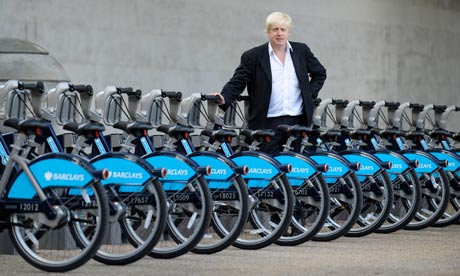
London: Barclays Cycle for Hire


London’s bicycle sharing scheme, Barclays Cycle Hire (BCH), scheme was introduced in 2010 by Mayor Boris Johnson and is touted as a catalyst for London’s cycling revolution. Barclays Bank funded a majority of the initial scheme, with operations fully funded by Transport for London. The scheme is often referred to as Boris Bikes after the Mayor and several community forums like this are fast gaining popularity. BCH gained instant success, with six million trips made in the first year alone, totaling almost 15 million trips since its inception and reaching a record high during the London Olympics in 2012. Although, Mayor Johnson is credited for the BCH scheme, it was actually first announced by the previous mayor, Ken Livingstone in 2007. The scheme drew inspiration from its European counterparts and is heavily modeled after the Velib, Paris’ bike share scheme.

Boris Bikes

Monday, May 13, 2013

Crossrail Shapes the Future of Transit Oriented Development in London


London seemed to take stock of itself in 2000 and 2001 regarding growth and planning with the creation of the Transport for London and the production of the Urban White Paper. The former is the governmental agency in charge of all transportation aspects of Greater London. The later is the document or report calling for, “better design in cities and the provision of affordable homes”. Both serve as guides for dealing with the projected growth London will encounter in the future.

Sunday, April 28, 2013

Health Impact Assessments and their Influence on London’s Transportation Policy


Health Impact Assessments (HIAs) have been informing transportation policy in London since the early nineties, when several reports were published, establishing a direct link between health and transportation. These reports offered HIAs as a tool to mitigate the adverse health impacts and maximize the health benefits of transportation policies. HIAs have played a major role in aiding London’s recent cycling revolution and raising awareness for the need to reduce auto-dependency. They have also been used as a tool to address inequities existing in the current transportation system and public health programs that seem to ignore older population, children and depraved population.

Monday, April 22, 2013

London Fog


Historically, London has wrestled with poor air quality from point source polluters like homes and factories most often relying on coal to either heat or operate their facilities. As these emitters have evolved, updated and cleaned up their processes the source of pollutants has become more democratic, shifting away from single source to the many hundreds of thousands of vehicles on the roads each day instead.  The impact being that the problem continues but from a new source, says Joan Walley MP chair of the Environmental Audit Committee, ‘It’s a scandal that the same number of people are dying of air pollution in London now as back in the 1950’s.’

London Haze. Source: The Guardian

Monday, April 15, 2013

Congestion and Cost

With the understanding that London is slated to increase to nine million people by 2020, or +13% from where it is now, efforts are being made to ensure that their transportation system will be both financially stable and suitably accessible to those in the future.

Traffic Safety in London: A look at recent planning efforts


Traffic safety in London is managed as per the 2001 London Road Safety Plan that sets a target of 40% reduction in all traffic casualties by 2010. Most traffic safety concerns pertain to Pedestrian and Cyclist safety, particularly among young children. Measures for traffic safety include monitoring traffic speeds, establishing partnerships with police and local government DOTs, planning for vulnerable users, implementing safer routes to school and the congestion charge.

Monday, April 8, 2013

London's Transportation System: Introduction


As with many large cities the transportation system of London is multi-faceted. The Transport of London (TfL) is the executive agency tasked with overseeing and managing the publicly owned transportation lines including, the Underground (London’s subway system) or the ‘Tube’, the London buses, Tramlink, Docklands Light Railway (which provides primarily east London), and the London Overground Transport.

History of Transportation in London: Humble Beginnings


In the early eighteenth century, like most major cities across the world, most people in London got around by foot or horse-drawn carriages – as they had for centuries. Pedestrians shared the narrow roads with animals, carriages of the affluent, various wagons and carts. The river Thames served as an east-west thoroughfare, connecting London to downstream ports like Essex, Kent and the coast for local and overseas trade. However, in the next two hundred years, rapidly growing London had to seek other, faster modes of travel, laying the foundation of the present day transportation system.