Portland Metro refers to the phrase
“active transportation” as sustainable, multimodal transportation solutions
that connect people to where they need to go (ODOT). At a local level,
infrastructure is incorporated in city design in order to allow people to
access what they need easily. Pedestrian focused design encourages people to
get out of their cars and be active by walking, biking, and taking public
transportation. It increases physical activity, decreases air pollution and gets people moving in and around their communities.

Transportation Problems and Policy - class blog for USP 456/556 at Portland State University
Showing posts with label Active Transportation. Show all posts
Showing posts with label Active Transportation. Show all posts
Monday, June 10, 2013

Portland should embrace new bike share technology
Bike sharing systems have skyrocketed in popularity over the
last 10 years in the United States. Minneapolis, Washington DC, Denver,
Philadelphia, Boston and now New York have extensive networks of bike sharing
docks placed on street corners, plazas and parks throughout the city. The
docking station was the key innovation that addressed issues of security,
payment, and circulation that plagued past attempts to implement a bike sharing
scheme. But new technology
is integrating the functions of the docking station into the bikes themselves,
offering promising benefits to both users and operators that may catalyze
another wave of expansion of bike sharing in the future. Portland, the top bike
city in the country, should lead the way in deploying this technology when they
roll out bike sharing next year.
Active Transportation and The War On Obesity
Fatness – being overweight/obese is in most cases a symptom,
not a negative health outcome in itself. It is defined by the ratio of your
height to your weight and doesn’t take into account body composition, i.e.
whether this height and weight ratio comes from a body builder, someone with
excess fat, a pregnant woman, or someone with excess fat who had a leg
amputated and consequently has the “right” height to weight ratio. It’s too
blunt of an instrument to take into account whether someone’s bone structure
and musculature resembles a refrigerator or a giraffe. It doesn’t consider how
much exercise someone is getting, whether their calories are coming from
produce or deep-fried Mars bars, genetics, stress, exposure to environmental
contaminants… essentially, it is just about the bluntest means of talking about
health that the field of health has. We only hear about it so prevalently for
two reasons: 1) it gets used frequently in studies because it is quick, easy,
painless, and cheap to measure someone’s height and weight. Especially compared
to drawing blood or performing a cardiovascular stress test. 2) it’s in the news all the time, not because
it is terribly relevant, but because a three-letter abbreviation (BMI) is more accessible
to the general population than medical terminology like “adipose tissue” and “lipid
profile”, and articles about fat get clicked on. That’s why you see ads like


Because it works. People click on that stuff like crazy. And
what’s on the cover of supermarket tabloids?


But cardiovascular disease isn’t caused soley by a few extra
inches on your waist. It’s a subtle distinction between correlation and causation:
for most of us, poor diet and exercise habits (A) cause fat cells to grow (B) and a long list of
health problems (C). But this is a case of A causes B, and A causes C. B did
not cause C, except in the case of mechanical issues (sleep apnea) and hormone-mediated
diseases like diabetes and some cancers. People who won the genetic lottery and
can eat junk food and watch tv all day without gaining weight are still
increasing their risk of dying, and someone who is overweight but eats well and
exercises might live to see 97. The greatest increase in health from exercise
is reaped by people who are just transitioning from a sedentary lifestyle to an
active lifestyle – before any weight loss is likely to have occurred [1].
Reminding girls that they are girls decreases their test
scores (the official terminology from psychology is “stereotype threat”)[5], and
the appearance of girls and women is heavily policed and held to a mostly
unobtainable standard [6], so it doesn’t seem to be a stretch that constantly
talking about fatness could make people who aren’t thin feel like there isn’t a
place for them in “bicycle culture” or other forms of active transportation. I
wondered if I might be the only person to worry about this, but Google quickly
turned up Ms. Kinzel’s experience:
“I’m using the elliptical trainer
at the gym. A man walks by and gives me an encouraging pat on the shoulder.
“GOOD FOR YOU!” he says loudly, pointedly, a little patronizingly.
His
intentions may well be positive, but in reality he has drawn attention to the
perceived discrepancy between my apparent interest in exercise and the size of
my body. He has pointed out that seeing people who look like me exercising in
public is a strange and unfamiliar occurance, an idea rooted in the assumption
that fat people are uniformly lazy and unhealthy, and I, as an exception,
therefore deserve to be recognized and lauded. I feel singled out and othered,
and very uncomfortable.” [4]
1. Running Doc:
Biggest health benefits from exercise come when sedentary people start a
program. (n.d.). NY Daily News.
Retrieved June 10, 2013, from http://www.nydailynews.com/sports/more-sports/exercise-benefits-start-program-article-1.1336187
2. Dreifus, C.
(2012, May 14). A Mathematical Challenge to Obesity. The
New York Times. Retrieved fromhttp://www.nytimes.com/2012/05/15/science/a-mathematical-challenge-to-obesity.html
3. Parker-pope,
T. (2011, December 28). The Fat Trap. The New York Times.
Retrieved from http://www.nytimes.com/2012/01/01/magazine/tara-parker-pope-fat-trap.html
4. What’s Wrong
With Fat-Shaming? (n.d.). Retrieved June 10, 2013, fromhttp://www.xojane.com/issues/whats-wrong-fat-shaming
5. Matthew S. McGlone, Joshua Aronson, Stereotype threat, identity salience, and spatial reasoning, Journal of Applied Developmental Psychology, Volume 27, Issue 5, September–October 2006, Pages 486-493, ISSN 0193-3973, 10.1016/j.appdev.2006.06.003.
6. Pretty much all media.
Op-Ed: Oregon Needs Mobility Education
Oregon’s graduated licensing program has received much
praise in its effectiveness at reducing crash rates for teen drivers. Given
this success, I propose that the state continue to lead the nation in driver
preparedness by instituting mobility education, starting at the elementary
school level. This recommendation focuses on the state level because the Oregon
Department of Transportation already handles driver education within the state.
Furthermore, instituting this novel idea as a pilot program within the state
will allow for gradual adoption and flexibility in implementation.
Sunday, June 9, 2013
Dangerous by Design: Portland's Unsignalized Intersections
 |
| Source: BikePortland.org |
The image above depicts the current intersection treatment at NE Going Street, looking north on Martin Luther King Jr. Boulevard (MLK).
Imagine you are a cyclist at this intersection, crossing the seemingly always-busy MLK by riding west on NE Going Street. As you wait for the traffic to pass you notice a car in the right-hand lane slowing to a stop just before the “zebra crossing.” The motorist looks at you and begins waving their hand, nodding and mouthing “go ahead.” Their behavior clearly states, “proceed, I am stopping for you.”
This is where the problem begins.
Monday, June 3, 2013
Op-Ed: Active Transportation in High School: A New Frontier
“New technologies such as computers and gaming systems
have also increased the quantity of choices for sedentary entertainment. At the
same time, many American children now live in a physical environment that
discourages physical activity,” (Clark, 2011). This is from “The Effect of
Low-cost Incentives on Active Transportation to School Rates among Elementary
School Students,” a research article with a focus on a certain age demographic.
Elementary schools are often targeted for active transportation (AT) programs,
so research information geared towards young children is plentiful. However,
one of the age demographics that often get overlooked when it comes to AT
outreach is high school students.
Saturday, June 1, 2013
Bicycle Tourism as Economic Stimulus: Seriously?! Yes, Seriously.
$400 million. That’s how much bicycle tourism, in Oregon, generated in 2012.
 |
| Travel Oregon announces bicycle tourism success on Twitter. Source: Author |
Friday, May 31, 2013
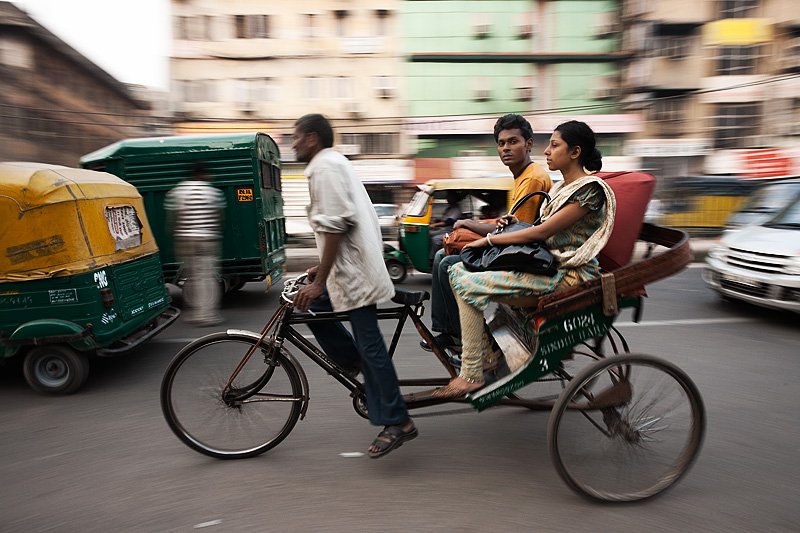
Op-Ed: Saving the Cycle Rickshaw
Growing up in India, I’ve used about nine different modes of
transportation to get to school every day. My favorite was the Cycle Rickshaw
(or the pedicab), as the operator (the rickshaw cyclist?) would sometimes let
my friends and I take turns driving it back home. With the advent and
subsequent monopoly of motorized and faster modes of travel on Indian roads,
the Cycle Rickshaw population is dwindling. Increasingly, they are being banned
from cities due to their poor integration with motorized traffic and deteriorating
public image. In this post, I’ll talk about the problems faced by this mode, why
they are a critical component for the Indian city, and some innovative grassroots
initiatives focused on bringing back the Cycle Rickshaw.
 |
| Cycle Rickshaws on a busy road |
Chicago's Pedestrian Scramble
Today was the first day people could legally cross a busy downtown Chicago intersection diagonally. At the intersection of State and Jackson Chicago has introduced a test pedestrian scramble that will allow pedestrians to cross the intersection in six ways, the cardinal four and the two diagonals.


The pedestrian scramble is intended to reduce conflicts between turning vehicles and pedestrians by letting pedestrians get a head start as well as their own time on the road. For 35 seconds of every third light cycle pedestrians can cross in all directions. The experiment will run for several months to collect data and feedback before deciding if the scramble will become permanent and, perhaps, spread to other intersections in the city.
Friday, May 24, 2013
The Use of Bicycles as Disaster Relief Tools
 |
| Could this be the new frontier for disaster response? Source: Bikeportland.org |
Tuesday, May 21, 2013
Suburbia as Smart Growth
This may not make you very comfortable to hear. Suburbia may have inadvertently arranged
itself, despite our grumblings and crinkled noses, in a manner that shockingly
resembles that of Smart Growth or New Urbansim.
Now before you brush me off as some mild-mannered troll, let me say that
I do not mean all of suburbia. I’m
not talking about single-family housing (there is no hope for that), but rather
I’m referring to multifamily housing. An
Oregon
Transportation Research and Education Consortium (OTREC) report states that
“since 1970 suburban multifamily housing has been the largest growing family
housing market” and currently comprise a quarter of the housing units in the
suburbs. It goes on to say that these
units are typically built 20 to 30 an acre, which is a sufficient density,
according to an Access
report, for a bus or even light rail corridor.
Monday, May 20, 2013
Shifting Away from Automobilities
As we've covered previously, Mexico City has experienced dramatic change over the last five years to its transportation system. Long regarded as one of the worst commuter cities in the world, Mexico City has seen such growth that they received the 2012 Sustainable Transport Award from the Institute for Transportation and Development Policy (ITDP). This can be attributed to the city's system-wide shift away from automobility planning towards a multimodal approach emphasizing transit and active transportation options.
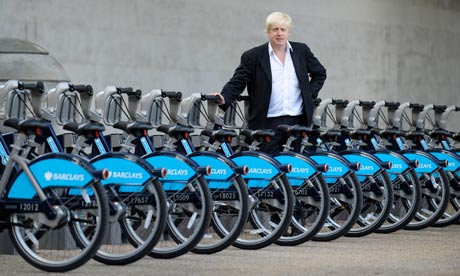
London: Barclays Cycle for Hire
London’s bicycle sharing scheme, Barclays Cycle Hire (BCH),
scheme was introduced in 2010 by Mayor Boris Johnson and is touted as a
catalyst for London’s cycling revolution. Barclays Bank funded a majority of
the initial scheme, with operations fully funded by Transport for London. The
scheme is often referred to as Boris Bikes after the Mayor and several
community forums like this are fast
gaining popularity. BCH gained instant success, with six
million trips made in the first year alone, totaling almost 15 million
trips since its inception and reaching a record high during the London Olympics
in 2012. Although, Mayor Johnson is credited for the BCH scheme, it was
actually first announced by the previous mayor, Ken Livingstone in 2007. The
scheme drew inspiration from its European counterparts and is heavily modeled
after the Velib, Paris’ bike share
scheme.
 |
| Boris Bikes |
The Next Evolution in Bike Sharing
In just the last few years, many U.S. cities have caught on
to the formerly European phenomenon called bike share. As bike sharing programs
open across major cities in the U.S., many of them have seen great success with
higher than expected rider turnouts fueling the expansion of these systems.
However, one major piece of equipment has been keeping bike sharing out of
smaller markets: the docking station.
Sunday, May 19, 2013
Vintage Bicycles Boom
 |
| Peugeot in the Portland snow. Source: Hart Ryan Noecker |
If Portland is known for one thing other than rain, it’s bikes. Lots of them. Take a look at what types of bikes most people are riding and you’ll see skinny tire, steel frame 10-speed bikes from decades past. Or, as some may say, “vintage bikes." And by vintage, I am referring to bicycles that hark back to an era of cycling simplicity, from the 1970’s through the 1990’s.
In Los Angeles, Every Lane is a Bike Lane
 | ||||||
| One of many Metro bus banners encouraging Los Angels to share the road[4] |
In Los Angeles, cars clearly dominate the roads. However, in spirit of
expanding and promoting cooperation with all users of the streets, Los
Angeles Metro created the “Every Lane is a Bike Lane” (ELBL) campaign.
Aimed primarily at automobile users, the push behind ELBL is to bring
increased awareness to cycling “without showing cycling as reckless or
dangerous.”[1]
Saturday, May 18, 2013
The Ciclovia and Cicloruta Programs in Bogotá

There have been major investments in pedestrian and bicycle
infrastructure in Bogotá, mostly started during Mayor Peñalosa’s term in
office. Two of the programs specifically designed for bicycles are the Ciclovia
and the Cicloruta.
Op-Ed: The Benefits of Active Transportation for Children

Children need to take a more active
role in transporting themselves to school.
In 2001, only 13% of school children walked or bike to school, compared
to 41% in 1969 (McDonald & Aalborg, 2009).
Coincidentally, the obesity rate has increased from 4.2% to 17% in
children ages 6 to 11 (McMillan,
2009).
Tuesday, May 14, 2013
Op-Ed: The Downfalls of Helmet Use

Just so we’re clear, I do not have anything against helmets aesthetically. In fact, my hair is never more cooperative than on days when it’s spent 30+ minutes under my helmet, giving it a side-swept, slightly tousled look that us queer women usually only dream of pulling off without gobs of hair wax and product. However, my argument looks beyond these style benefits and analyzes not only the true safety aspects of helmets, but also the message that they give to users and onlookers.
Subscribe to:
Posts (Atom)