Bike sharing systems have skyrocketed in popularity over the
last 10 years in the United States. Minneapolis, Washington DC, Denver,
Philadelphia, Boston and now New York have extensive networks of bike sharing
docks placed on street corners, plazas and parks throughout the city. The
docking station was the key innovation that addressed issues of security,
payment, and circulation that plagued past attempts to implement a bike sharing
scheme. But new technology
is integrating the functions of the docking station into the bikes themselves,
offering promising benefits to both users and operators that may catalyze
another wave of expansion of bike sharing in the future. Portland, the top bike
city in the country, should lead the way in deploying this technology when they
roll out bike sharing next year.

Transportation Problems and Policy - class blog for USP 456/556 at Portland State University
Showing posts with label Portland. Show all posts
Showing posts with label Portland. Show all posts
Monday, June 10, 2013

OpEd | State | TriMet angers many, requires oversight
 |
| Photo credit: KGW.com |
Did you know that TriMet fares are now among the highest in
the nation (Gianola, 2013) ? That’s right, a
monthly adult TriMet pass is $100, while in Philadelphia, its $83, $72 in Los
Angeles and just $70 in Boston (Gianola, 2013) . Yet all three
cities have operation far more extensive than Portland’s. So why does public
transit cost so much in Portland? TriMet General Manager Neil McFarlane wants
you to blame the recession and the high cost of TriMet’s union health benefits (Gianola,
2013) .
He hoped you wouldn’t find out about the $910,000 in pay raises he approved for
the highest echelon of TriMet management in 2012, even as he publicly stated
that he had frozen their pay (Rose, 2013) . “How could this happen
right under our noses?” you may ask. This was able to happen because no one was
watching. While TriMet management increased fairs, cut service, and gave
themselves raises, no one was paying attention. To ensure this can’t happen
again, Oregon lawmakers have called on Secretary of State Kate Brown to conduct
an unprecedented audit of operations and finances at the state's largest public
transit agency (Rose J. , 2013) .
Vice-chair of the House Committee on Transportation and
Economic Development, Rep. Chris Gorsek (D-Troutdale) is the chief sponsor of
the proposal, an amendment to his House Bill 3316. HB3316 was intended to regulate
TriMet’s governance, transferring operational and finical oversight from TriMet’s
board of directors to Metro (Staff, 2013) . However, Gorsek simultaneously
realized he didn’t have wide support for restructuring and became aware of
major management issues at TriMet. He took the opportunity to push for a large
scale audit instead (Rose J. , 2013) . While the audit will
possibly take longer than the original plan - Brown's office plans to have the
audit finished before the 2014 legislative session (Thompson,
2013)
– it ensures a much more thorough understanding
of exactly what is going on inside the transit agency and why. This is
an extremely prudent step, prior to taking any major action which could have unforeseen
repercussions. While it’s obvious that things need to change inside TriMet, I believe
it’s worth taking the time to do it right.
Op-Ed | Local | Idling Reduction: A Common Sense Plan

Old habits are hard to break. To most, idling
a car may seem fairly harmless, but in fact, there are many adverse effects.
Carbon emissions have a major impact on air quality, with implications for public
health and the environment, as we all know. One way to lessen these emissions
is to reduce needless pollution from idling. However, most drivers don’t think
twice about running their engine while the car is not in motion. For this
reason, the City of Portland and Multnomah County need to work together to
create idling regulations for passenger vehicles.
The two municipalities have worked together briefly on this
issue before, during the “Idling Gets You Nowhere” public outreach campaign in the
summer of 2011. As part of that effort, Mayor Adams’ office convened an idling
reduction task force to look into various options for addressing the
issue. Multnomah County took the lead on
outreach by creating an informational website, hanging “Idling
Gets You Nowhere” banners across the Hawthorne Bridge and mobilizing volunteers
to hand out postcards explaining the dangers of vehicular idling during bridge
lifts and at community events.
The partnership makes sense in
light of the two municipalities’ efforts to reduce carbon emissions. In 2009,
the City of Portland joined forces with Multnomah County to adopt the ClimateAction Plan, a three-year plan to put us on a path to achieve a 40 percent
reduction in carbon emissions by 2030 and an 80 percent reduction by 2050. “The
Climate Action Plan commits the City and Multnomah County to 93 actions over
the next three years and establishes 18 objectives for 2030 (City of Portland,
2009).” However, in the whole 70 page document, idling is mentioned only twice.
Sunday, June 9, 2013
Dangerous by Design: Portland's Unsignalized Intersections
 |
| Source: BikePortland.org |
The image above depicts the current intersection treatment at NE Going Street, looking north on Martin Luther King Jr. Boulevard (MLK).
Imagine you are a cyclist at this intersection, crossing the seemingly always-busy MLK by riding west on NE Going Street. As you wait for the traffic to pass you notice a car in the right-hand lane slowing to a stop just before the “zebra crossing.” The motorist looks at you and begins waving their hand, nodding and mouthing “go ahead.” Their behavior clearly states, “proceed, I am stopping for you.”
This is where the problem begins.
Friday, June 7, 2013
State Funding of Bike Pedestrian Programs Op-Ed
The Problem:
When we look at the current trend of the Federal Government
they have gotten out of the business of funding large infrastructure project in United States. The current US Secretary of Transportation has had pressure put on him to
make the budget for infrastructure funding even smaller at the state level.
Programs like “safe routes to schools” and “National Transportation Alternative
Clearinghouse” have been cut back drastically and are leaving the majority of
the free money for investment in the programs that support bike and pedestrian
infrastructure gone. This brings into to question whether our growing
population of bikers in Portland will slowly begin to decline and our goals of becoming
“Bike City, USA” will disappear as well.
Thursday, June 6, 2013
Op-Ed: East Portland Bus Stops Deserve Attention
Inequity manifests itself in many ways within the City of
Portland. In a city that prides itself on its progressive policies and green
transportation options, the disparities in TriMet’s bus stop accommodations are
inexcusable. The contrast between the built environment and amenities at bus
stops in Central Portland versus East Portland is abhorrent and needs to
change. I implore TriMet to prioritize improvements to the “top three” worst
bus stops, as identified by OPAL’s (Organizing People, Activating Leaders) East
Portland Bus Project.
Tuesday, June 4, 2013
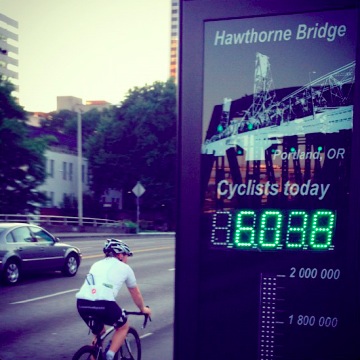
Op-Ed: Volunteer Bike Counters Will Be Out of Work!
 |
| Bikeportland.org |
The Portland City Club’s report on bicycles has
done a very comprehensive job of summarizing the current state of affairs and
future of cycling in Oregon. With the report’s release everyone has been abuzz
about the recommendation for a 4% tax on new bike sales. I’m on the fence over
whether it’s necessary or not. I want to look past the bike-tax that has been
making the headlines and look at one of the things the tax would be used to pay
for: automatic bike counters, like the one on Hawthorne Bridge. More automatic bike counters
around the city will mean hundreds of volunteer bike counters will be out of
work. And that’s a good thing, because automatic bike counters will provide
more data to support future bike infrastructure and volunteer bike counters
will be free to pursue other unselfish civic co-production commitments.
Sunday, June 2, 2013
Local Op-Ed: Extend and Improve the Old Town / Chinatown Pedestrian Zone!
 |
| Old Town / Chinatown Pedestrian Zone. From The Portland Mercury |
Picture this: it's midnight, and downtown is alive with activity. The sidewalks are filled with people enjoying sidewalk dining in the cool night air, and crowds of pedestrians wander the streets. Pedi-cabs slowly work their way though the revelers, and all without a car in sight! This could be the future of Portland's Old Town/Chinatown district, but only if the City Council makes the right decision this week. Since early this year a small part of the city has been closed to vehicles on weekend nights, creating a safer and more welcoming area for pedestrians. Residents, nearby businesses, the Portland Police Bureau, and the Mayor have all expressed their support for the program (Oregonian).
 |
| Area Closed to Cars. From Portland Office of Neighborhood Involvement |
But without City Council action, cars will soon return to the streets and once again create a nightly scene of congestion and conflict. By voting to extend and improve the program when they meet June 5th, City Council can help create a safe, vibrant nightlife for Portland and again demonstrate that this is a city that values its pedestrians (City Council Ordinance).
Saturday, June 1, 2013
Bicycle Tourism as Economic Stimulus: Seriously?! Yes, Seriously.
$400 million. That’s how much bicycle tourism, in Oregon, generated in 2012.
 |
| Travel Oregon announces bicycle tourism success on Twitter. Source: Author |
Thursday, May 30, 2013
Op-Ed: Portland: Replace parking minimums with parking markets
Parking isn’t free. The assumption that it has no costs or
the stipulation that it should be free ignore the fact that space is a scarce
resource. Scarce resources have value and public policy is incredibly
influential in determining how that value is allocated in the marketplace.
Minimum parking requirements distort the markets for land and transportation by
bundling the costs of parking with the costs of housing. Portland should repeal
the recent decision to set minimum parking requirements for new apartment buildings
over 30 units. In its place, the city should provide neighborhoods the option
to create a well-functioning, well-regulated local parking market through
Parking Benefit Districts. (Kolozsvari and Schoup 2003)
Wednesday, May 29, 2013
Does the MAX increase property values?
There have been many inquiries into how proximity to a light
rail or rapid rail station affects values of nearby properties.
Monday, May 27, 2013
The P Word... and its controversy.
Parking. Everyone seems to have an opinion on parking. Some people
think we need more, some think we need less. Some are adamant about parking
requirements for new developments and some say parking requirements prevent
development from happening in the first place. Donald Shoup believes the latter.
His article “Free Parking or Free Markets” makes a strong case that the cost of
parking is usually hidden and placed on non-drivers. His study on parking
requirements and the effects of parking policy makes a strong case for reducing
requirements in order to spur infill development and promote the reuse of older
buildings.
Friday, May 24, 2013
The Use of Bicycles as Disaster Relief Tools
 |
| Could this be the new frontier for disaster response? Source: Bikeportland.org |
Tuesday, May 21, 2013
Suburbia as Smart Growth
This may not make you very comfortable to hear. Suburbia may have inadvertently arranged
itself, despite our grumblings and crinkled noses, in a manner that shockingly
resembles that of Smart Growth or New Urbansim.
Now before you brush me off as some mild-mannered troll, let me say that
I do not mean all of suburbia. I’m
not talking about single-family housing (there is no hope for that), but rather
I’m referring to multifamily housing. An
Oregon
Transportation Research and Education Consortium (OTREC) report states that
“since 1970 suburban multifamily housing has been the largest growing family
housing market” and currently comprise a quarter of the housing units in the
suburbs. It goes on to say that these
units are typically built 20 to 30 an acre, which is a sufficient density,
according to an Access
report, for a bus or even light rail corridor.
Sunday, May 19, 2013
Vintage Bicycles Boom
 |
| Peugeot in the Portland snow. Source: Hart Ryan Noecker |
If Portland is known for one thing other than rain, it’s bikes. Lots of them. Take a look at what types of bikes most people are riding and you’ll see skinny tire, steel frame 10-speed bikes from decades past. Or, as some may say, “vintage bikes." And by vintage, I am referring to bicycles that hark back to an era of cycling simplicity, from the 1970’s through the 1990’s.
Sunday, May 12, 2013
Hiking the Fines for Bicyclists Breaking Traffic Laws
Chicago is taking action against bicyclists that break
traffic laws and drivers and passengers that open their doors onto bicyclists
by subjecting them to pay steeper fines.
Chicago Mayor Rahm Emanuel announced the fines would
increase from $25 to a minimum of $50 and a maximum of $200 for bicyclists that
violate traffic laws. Additionally,
passengers and drivers that “door” a bicyclist would face a fine increase from
$500 to $1,000. Fines for leaving a door
open would double to $300.
 |
| Two-way Protected Bicycle Lanes on Dearborn Street, Credit: John Greenfield |
Thursday, May 9, 2013
Absenteeism and Overtime Pay in Trimet
 Trimet has recently
made the news for its problematic overtime policy for bus and rail
operators. Revelations show a lack of regulation at both the State
level and within Trimet itself. Current Trimet rules state
that light rail operators are required to take seven hours off between shifts, operators can’t work more
than 17 hours during a 24 hour period, and that after 13 straight days of
working, bus and rail operators are required to take the next day off. A recent article reported that a single Trimet bus
driver earned upwards of $116,624 in 2012, with $64,408 of that being
overtime pay. Apparently working 70
hours a week for fifty-two weeks straight is a lucrative decision. Or is it?
Trimet has recently
made the news for its problematic overtime policy for bus and rail
operators. Revelations show a lack of regulation at both the State
level and within Trimet itself. Current Trimet rules state
that light rail operators are required to take seven hours off between shifts, operators can’t work more
than 17 hours during a 24 hour period, and that after 13 straight days of
working, bus and rail operators are required to take the next day off. A recent article reported that a single Trimet bus
driver earned upwards of $116,624 in 2012, with $64,408 of that being
overtime pay. Apparently working 70
hours a week for fifty-two weeks straight is a lucrative decision. Or is it?Saturday, May 4, 2013
Survey Says . . .
The Metro Climate Smart Communities Online Survey was
conducted between March 26th and April 8th 2013 by Davis, Hibbitts, &
Midghall, Inc. (DHM Research), in partnership with Opt-In to help Metro form a
strategy to meet the State of Oregon ’s
2007 requirement to reduce greenhouse gas emissions from cars,
Tuesday, April 23, 2013
CRC and Evolving Transportation Funding
Over the past week or so there have been a number of articles written about Portland's own CRC project from an outside perspective. DC Streetsblog in particular has taken an interest with the recent press the CRC has received. Secretary LaHood's final appearance before the House and President Obama listed the CRC as one of the potential projects for New Starts funding. Regardless of your stance on the CRC, this is a prime example of a conflict between more traditional transportation planning and the evolving realities of funding today.
Monday, April 22, 2013
Do Not Remove the NB I-5 HOV Lane, Please!
This article
is from September of last year, but it appears to be a timeless discussion
regarding the northbound (NB) I-5 HOV lane in North Portland. It is no surprise why the HOV
lane was implemented along this corridor in the first place: a demand control
strategy to get more people to share rides or take transit. Let's look back a
few years: the HOV lane was implemented along the NB I-5 in North Portland and another
southbound (SB) HOV lane was implemented in Clark County, WA, just north of the Interstate
Bridge. In 2005, the SB lane was removed, but the NB lane
continues through North Portland.
Subscribe to:
Posts (Atom)