Walking on the
Amtrak platform with my rolling luggage, I can’t keep myself from smiling. I
love trains, for ecological and recreational reasons, and the fact that my
partner and I are currently replacing round-trip cross-country flights with
train trips makes me love them even more. And seeing a large majority of seats
full gives me hope that one day train travel will become a viable travel option
again for the American population.

Transportation Problems and Policy - class blog for USP 456/556 at Portland State University
Showing posts with label Amtrak. Show all posts
Showing posts with label Amtrak. Show all posts
Sunday, June 9, 2013

Tuesday, May 28, 2013
Op-Ed: California Should Dump Amtrak
It’s
crunch time for the states that have Amtrak trains that travel less than 750
miles (unless they are on the northeast corridor), since the states will now be
responsible for all expenses related to those trains. For many years states
have funded trains under the 403b provision of Amtrak law including California,
Oregon, Washington, Illinois, Michigan, and North Carolina but now will be
required to fund the entire amount even on trains that are currently not funded
by the state. However, the state of California is in the unique position to run
their trains themselves and probably save some money along the way.
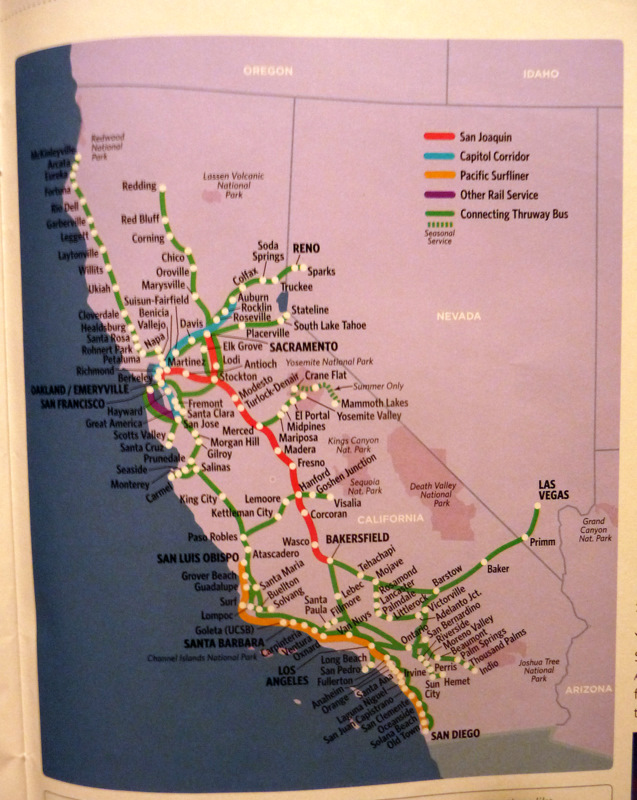
Currently
the state of California
 |
| Photo by JoeinSouthernCalifornia |
All
of this success can be contributed directly to the hard work of various
branches of the state of California and the many advocates of rail passenger
service that have worked very hard for the progress the state has seen. In fact
the state of California is one of the few states that have dedicated funds for
rail passenger service that were approved by the voters (although there were
various attempts by former Governor Schwarzenegger to raid the funds).
In
fact Amtrak itself has had very little to do with the success of rail passenger
service in the State of California and in many cases has been a roadblock to
progress in the state. Way back in 1986 former California State Senator Jim
Mills, who as mayor of San Diego was instrumental in creating the first new
modern light rail system in the United States, wrote a damming store in San
Diego magazine showing how Amtrak had repeatedly created road blocks to
improving the line between San Diego and Los Angeles. (Mills, 1986)
Another
factor in why California should go it alone is the high cost of dealing with
Amtrak. Over the last few years Amtrak has lost most of their contracts to
provide commuter rail service because of how expensive they are. In addition
there have always been questions about Amtrak’s accounting and what the true
costs are to provide the service and how much money is actually syphoned into
the northeast corridor. Once again the state of California is in a perfect
position to find another operator with the extensive network the state
currently has.
With
any action there is going to be unintended consequences of actions taken, so in
the case of California going on its own, what will be the consequences?
First
of all the agency that will run the service will have to negotiate new
agreements with the railroads. This will probably be fine with the BNSF who has
been very cooperative in rail passenger service in California but the Union
Pacific would probably be harder. However, considering the amount of trains
that are already running on UP tracks and that the state already has an
agreement with the UP that provides them better compensation than running a standard
Amtrak train, there is no reason why the agreements should not be able to be
made.
Second,
Amtrak owns most of the equipment used on the Surfliner service from San Diego
to San Luis Obispo along with most of the locomotives so the state will have to
either purchase the equipment from Amtrak or be able to secure enough equipment
to use before taking over the service. The unknown is what would be Amtrak’s
reaction to losing its source of money coming in from California and what
tactics they may use in response. The state will also have to work to secure
rail yards to use although the possibility exist to create joint maintenance
facilities with the commuter railroads that cover both sides of the state.
This
will not mean that Amtrak will no longer operate in the State of California as
it still will provide service on its long distance trains which provide service
to many destinations. However, local service within California would now be
directly operated by the state of California.
California
is probably the only state that currently funds Amtrak 403b that is in a position
to take over those trains and run them instead. The State of California and
various advocacy groups are largely responsible for the success of rail
passenger service in California. If it had been up to Amtrak the San Diegans
would still be running 3 trains a day between Los Angeles and San Diego and the
highly successful San Joaquin and Capital Corridors would only be a dream. It
is time for California to take the next step and take complete control of their
trains.
References
Amtrak
California. (n.d.). Amtrak California. Retrieved May 28, 2013, from
http://www.amtrakcalifornia.com/
Mills, S. S. (1986, December).
Amtrak: The Public Be Damned. san diego magazine, 10, 2-10.
Vantuono, W. (2005, October). The
best in the West: Gene Skoropowkis's trains. Railway Age Magazine, 206,
10.
APA formatting by BibMe.org.
Subscribe to:
Posts (Atom)