Showing posts with label TOD. Show all posts

Monday, June 10, 2013

Transit Oriented Development Without The Transit

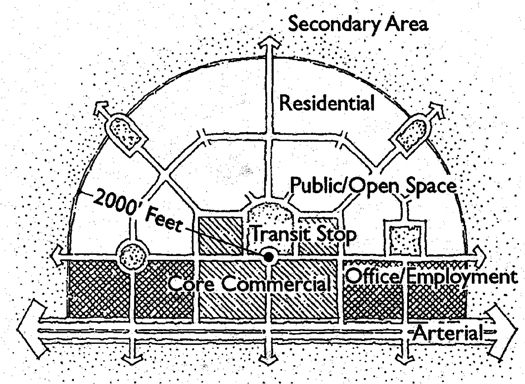
A recent article in The Atlantic Cities discusses something we recently talked about in class: TODs that are successful despite their limited connection to transit. In our discussion, we talked about several TODs in Portland that had compact, walkable environments that were not serviced extremely well by public transit. According to Eric Jaffe, the writer of the Atlantic Cities article, that might be okay.


Current conception of a "good" transit oriented development. Source: placemakers.com

Sunday, June 9, 2013

Op-Ed: Denver: Make transit-oriented living possible for everyone

The Denver region has an unprecedented opportunity to lead the country in shaping a more sustainable, livable and affordable metropolis. The public elected to invest over $6 billion into one of the largest rapid transit systems in the country, including 122 miles of light rail and 18 miles of bus rapid transit (1). The return on this investment will be measured not just by how many riders the system attracts, but by the social and economic backgrounds of those riders. Public transit cannot become luxury good only available to those who can afford to live near it. We need to demand smart and aggressive public policy to ensure housing around transit stations remains affordable to a wide range of people. Otherwise, we will continue to compound the inequities that stifle the social mobility of so many of our citizens.

Monday, May 20, 2013

How to interpret high transit ridership of TOD residents

Living within a walkable distance of a transit stop has been shown to significantly increase the likelihood that an individual will ride transit. Studies in the Bay Area and Washington DC found that residents within a half-mile of a rail stop were three to five times more likely to commute by rail (1). Public policy has sought to capitalize on this ridership bonus through a range of strategies to increase transit-oriented development (TOD), such as subsidizing or financing development near stations, rezoning, or lowering transportation impact fees.

Sunday, May 19, 2013

What was old is new again in Chicago...


While in Chicago for the American Planning Association Conference, one of the mobile workshops I attended was coverage of TOD on the Brown Line. The Brown Line travels from the Loop to Kimball which is in the northwest part of Chicago.  This ‘L’ has been around since the early 1900s and here you can see signs of Transit Oriented Development before anyone even dreamt up the term TOD. 

Over the last few years the Chicago Transit Authority has revitalized stations along the route, including lengthening of platforms, after the line saw a 79% increase in traffic since 1979 and a 27% increase from 1998. Subsequently there has been a revival of interest from developers along the line, with many classic TOD buildings being remodeled and infill development taking place.

Monday, May 13, 2013

East Midtown Rezoning Study: New York City Revisits the Ultimate TOD


Grand Central Terminal

Grand Central Terminal is one of New York's historic landmarks and a major transportation nexus, serving over half a million people each day.  The access provided by Grand Central Terminal helped grow the East Midtown area into one of the largest job centers in NYC.  East Midtown contains 70 million square feet of office space and 200,000 workers, as well as many of the City's iconic buildings and landmarks.

East Midtown Rezoning Area

The City is in the process of two new major transit projects that will bring even more commuters through Grand Central.  To complement the new transportation infrastructure, the City has proposed a dramatic plan to reshape zoning in East Midtown.  The plan creates a streamlined zoning process that will fund a dedicated pedestrian improvement program, encourage higher densities, and promote the creation of new iconic environmentally sustainable buildings.  It may not be Transit Oriented Development in the strictest sense, the plan is the City's latest effort to make sure transit and development are harmonious and mutually reinforcing.
Crossrail Shapes the Future of Transit Oriented Development in London


London seemed to take stock of itself in 2000 and 2001 regarding growth and planning with the creation of the Transport for London and the production of the Urban White Paper. The former is the governmental agency in charge of all transportation aspects of Greater London. The later is the document or report calling for, “better design in cities and the provision of affordable homes”. Both serve as guides for dealing with the projected growth London will encounter in the future.

Transit-Oriented Development in FasTracks


With the start of the FasTracks program, the RTD Board of Directors decided to revise their transit –oriented development (TOD) policy in order to allow for flexible and proactive planning of TOD during  rapid transit projects.

Sunday, May 12, 2013

TOD in Los Angeles: A New Wave of Thinking or Auto Oriented Development?

             Casden West Los Angeles is a proposed large-scale transit-oriented development (TOD) to be constructed near the planned Expo Line in the heart of West Los Angeles. The first of it’s kind for Los Angeles. This TOD project plans to add 638 luxury apartment units at the intersection of Pico Boulevard and Sepulveda Boulevard. When constructed, Casden West will top out at 17 floors, with six subterranean floors for 1,800 parking spaces. In addition to residential units, the Casden West project will feature mixed-use retail anchored by a Target store.[2]

The proposed Casden West project viewed from the planned Expo Line station
Source: casdenwestla.com

Mexico City: Land Use and TODs


Mexico City will have 12 million more inhabitants within the urban city by 2030. This intense growth projection has made transit oriented development a desired form of land use planning. Unfortunately, the capital city has unique and difficult land use laws that make TOD type policies difficult to implement. Since 2009, NGOs have been working with regional and local governments to begin the discussion and potential implementation of “Desarrollo Orientado al Transporte Sustentable (DOTS)”
The outer edges of Mexico City