Showing posts with label Current Events. Show all posts

Tuesday, June 11, 2013

(Bill 2452) Distance based user charge on EV in Oregon

Several states proposed a new road tax scheme including Washington, Virginia, New Jersey, Arizona, Texas, Oregon, San Francisco, Michigan. It seems distance based user charge would be alternative of the current gas tax in the long run. Because there is no tax on electric vehicles, the new road tax scheme will be tested on electric vehicles first. Here is House Bill 2452 which states distance based user charge on electric vehicles in Oregon.

According to House Bill 2452, the driver of high-mileage vehicle will pay distance based user charge or flat annual road usage charge in Oregon. High-mileage motor includes electric vehicles and vehicles that get 55 mpg or better. This bill would be applied for vehicles produced in 2015 or after.

The distance based user fee will be around 1.56 cents per mile, and for 15,000 miles electric vehicle drivers would pay $234. This rate is same with what a regular vehicle drivers pay in gas taxes. Also, there will be a penalty up to $2,000 for person who reports a false vehicle miles traveled.

There are three options of how to collect a new road tax. The first option is to use on-board GPS system or cell phone. The downside of this option is that it is disabled for some situations where a driver is not a owner of a vehicle for on-board GPS system, or registered drivers take a public transportation service for cell phone. The second option is an on-board mileage tracker. It would not record the location of vehicle but vehicle miles traveled. It can avoid privacy issue, but the records can be flawed by inability of recognizing between public roads, private land or out of state. The last alternative is a flat annual fee.

(resources)
1. Antony Ingram, Oregon, Too, Wants To Tax Electric Cars(And 55-MPG-Plus Cars Too)
2. House Bill 2453


Monday, June 10, 2013

OpEd | State | TriMet angers many, requires oversight

Photo credit: KGW.com

Did you know that TriMet fares are now among the highest in the nation (Gianola, 2013)? That’s right, a monthly adult TriMet pass is $100, while in Philadelphia, its $83, $72 in Los Angeles and just $70 in Boston (Gianola, 2013). Yet all three cities have operation far more extensive than Portland’s. So why does public transit cost so much in Portland? TriMet General Manager Neil McFarlane wants you to blame the recession and the high cost of TriMet’s union health benefits (Gianola, 2013). He hoped you wouldn’t find out about the $910,000 in pay raises he approved for the highest echelon of TriMet management in 2012, even as he publicly stated that he had frozen their pay (Rose, 2013). “How could this happen right under our noses?” you may ask. This was able to happen because no one was watching. While TriMet management increased fairs, cut service, and gave themselves raises, no one was paying attention. To ensure this can’t happen again, Oregon lawmakers have called on Secretary of State Kate Brown to conduct an unprecedented audit of operations and finances at the state's largest public transit agency (Rose J. , 2013).

Vice-chair of the House Committee on Transportation and Economic Development, Rep. Chris Gorsek (D-Troutdale) is the chief sponsor of the proposal, an amendment to his House Bill 3316. HB3316 was intended to regulate TriMet’s governance, transferring operational and finical oversight from TriMet’s board of directors to Metro (Staff, 2013). However, Gorsek simultaneously realized he didn’t have wide support for restructuring and became aware of major management issues at TriMet. He took the opportunity to push for a large scale audit instead (Rose J. , 2013). While the audit will possibly take longer than the original plan - Brown's office plans to have the audit finished before the 2014 legislative session (Thompson, 2013) – it ensures a much more thorough understanding  of exactly what is going on inside the transit agency and why. This is an extremely prudent step, prior to taking any major action which could have unforeseen repercussions. While it’s obvious that things need to change inside TriMet, I believe it’s worth taking the time to do it right.


House Bill 2195

Oregon House Bill 2195, which reads "Provides that physician or health care provider may at any time report to Department of Transportation that person's cognitive or functional impairment affects person's ability to safely operate motor vehicle, without regard to whether report is required by department." passed both the house and the senate in April, and was signed into law in mid May.  This bill, though somewhat indirectly linked to topics covered in this class, is still relevant to discussions around transportation policy and privacy.  
On the one hand, this bill provides an increase in road safety, something that's hard to argue against.  On the other, it removes an entire layer of doctor/patient confidentiality in a way that could seriously alter the way a person is required to live.  This alteration could lead to safer roads for everyone, but entirely violates the code of privacy that patients have previously relied on for protection.  
Increasing road safety is undeniable important, for other drives, bicyclists, pedestrians, and even the patient-drivers themselves, but privacy violation is a slippery slope, even for the Transportation Department.  This bill simply allows doctors to notify the Transportation Department and protects them from legal recourse, but this bill could also be used as a stepping stone in the future for laws that require the disclosure of confidential patient information.

Overall, it seems like a well-intentioned, but potentially harmful piece of legislation.  It puts lawmakers in a position that offers a great deal of power, in a nation with shrinking privacy rights.  Conversely, it puts drivers on safer roads.  Something of a conundrum...


Thanks to CJ Doxsee and Michael Armstrong for editing.


Sources:

Nicaragua's New Canal

Lake Nicaragua - Potential Pathway for New Canal
Source: Yahoo News (AP Photo/Esteban Felix)

This week, big news was announced in an area of transportation often forgotten in conversation – maritime transport! 

Saturday, June 8, 2013

Utah Transit Authority Completes Frontlines 2015 in 2013

English: A map of the light rail system in Sal...
English: A map of the light rail system in Salt Lake City, Trax, of the Utah Transit Authority. This map will be rendered obsolete by 2013, when the airport extension of the green line opens. (Photo credit: Wikipedia) -Note does not show the Airport Line which opened in April. 
While Denver’s Fastracks program is pretty impressive, in September the Utah Transit Authority (UTA) will mark the completion of its Frontlines 2015 project with an extension of their original north-south rail line from its current terminus at the Sandy Civic Center station into the city of Draper. This program added 70 miles of rail lines to their existing 64-mile rail network and is being completed ahead of schedule and at or below estimated cost.

The program included an extension of the Frontrunner Commuter Rail line from Salt Lake City to Provo, three new branches of the TRAX light rail system and the aforementioned Draper Line.  In addition to the Frontlines program, UTA has also opened a BRT line along 3500 South from the Millcreek TRAX station to the city of Magna (Utah Transit Authority). If that is not enough UTA is also building a streetcar line from the 2100 South TRAX station to the Sugar House area. While streetcars are generally looked upon with distain by many groups this one is using an existing rail line to provide a direct connect from the pedestrian-friendly Sugar House neighborhood to the heart of the TRAX network (Sugar House Streetcar).

Friday, June 7, 2013

Don’t Plan that Trip to Mars Just Yet (Space Travel is a Transportation Issue Too, Right?)


A recent article in USA Today described the ill effects of extreme radiation exposure in the event that humans travel to Mars. The article states that “…astronauts would likely receive a significant fraction, about 15% to 20%, of their lifetime allowable radiation dose on a round-trip to Mars,” a trip that is estimated to be about 6 months. The research and planning going into potential travel to Mars comes from President Obama’s space exploration plan, which he revealed in 2010. The plan also calls for possible travel to a nearby asteroid, and both of these plans are being spearheaded by NASA and private teams.

Thursday, June 6, 2013

Transit Racism in LA from a Grassroots Perspective

This isn't my official current events report. I just thought people might be interested in a recent article that I read in "The Nation" about transit racism issues and the defeat of Measure J in Los Angeles. The article was written by Eric Mann who is the director of the Labor/Community Strategy Center. Measure J was meant to allow $90 billion of federal funds over the course of 30 years be allocated to rail projects while simultaneously cutting bus service and raising fares, which mostly negatively affect low-income and minority groups. Below is the link to the article, but you might need a subscription to read it. I can bring the article to class on Monday in case anyone's interested. Happy Thursday!

http://www.thenation.com/article/174220/fight-soul-city-battle-over-buses-los-angeles

Tuesday, June 4, 2013

The Loss of Senator Frank Lautenberg - The Safety Senator

njfuture.com

Senator Frank Lautenberg passed away Monday at the age of 89. Transit riders across America benefited greatly from the senator’s efforts. In a statement on Monday, U.S. Transportation Secretary Ray LaHood said, “Frank’s tireless advocacy for transportation safety saved many lives - he truly was the Safety Senator”. Senator Lautenberg was influential for many of the country’s transportation policies including defending Amtrak from privatization, banning smoking in airplanes, stricter limits on blood alcohol content, and increasing the federal drinking age to 21.


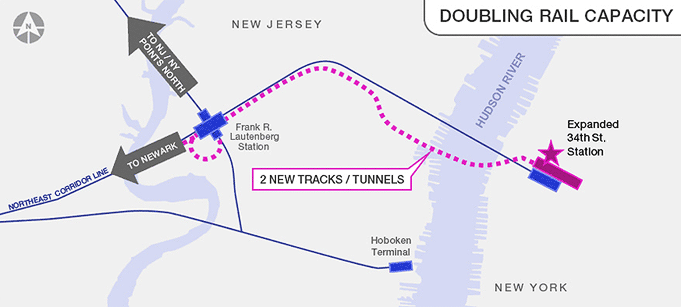
His most recent efforts were in securing funding for the trans-Hudson rail project known as the ARC tunnel (Access to Regional Core). The two-decade old project created news headlines beginning 2010 over the head-butting between Senator Lautenberg and Governor Chris Christie. He had secured $6 billion in federal funding for a transit tunnel under the Hudson River before the New Jersey Governor cancelled the project twice in one month, saying the potential cost-overruns would be too much.


Even though the ARC Tunnel had been cancelled by Governor Christie two years earlier, Senator Lautenberg continued diligently on another “Gateway” tunnel. The Senator secured $185 million cash-infusion from post-Sandy aid to build a concrete encasement preserving the right-of-way. Still a full tunnel is decades away according to WNYC. His last tweet was about securing the funds and laying the groundwork for a future tunnel.


media.nj.com
Governor Christie has maintained the feud saying that he is supportive of a second tunnel, just not the Senator’s ARC Tunnel. At a press conference on Tuesday he announced a special election in October to fill the vacant seat while describing the ARC Tunnel as “a dog that deserved to be gone”.

The Senator will be buried at Arlington Cemetery after being transported to D.C. by Amtrak. Amtrak released a statement saying, "We mourn the passing of Sen. Fran Lautenberg, a tireless advocate of Amtrak, passenger rail and improved mobility for the entire northeast region".

Reviewed by Chris Meyers

Sunday, June 2, 2013

Looking at an Oregon Carbon Tax

            In the May 16th edition of Sustainable Life, there was an article titled “Taxing Carbon Gets New Scrutiny”, regarding a carbon tax for the State of Oregon.  A carbon tax is a surcharge on gasoline, coal, natural gas, home heating oil, and other fossil fuels based on the greenhouse gases they emit.  Greenhouse

Friday, May 31, 2013

Tracking the Carbon Footprints of Megacities - They're Watching the Skies in LA


Cities are a major contributor to global anthropogenic greenhouse gas emissions, and increasingly policy is targeting the transportation sector as a means of curbing these emissions.  But the practice of determining exactly how much carbon dioxide, methane, carbon monoxide, and other greenhouse gasses (GHG) are being emitted is still primitive.


 The Megacities Carbon Project aims to change that, using the latest scientific advances in atmospheric monitoring to discover what's really in the air.  Doing so will allow cities to accurately determine if, and how, well their policies are working to curb global warming.


Wednesday, May 29, 2013

New Transit Hub in Minneapolis

Big changes for the city of Minneapolis are coming in terms of transportation projects. Hennepin County is pushing for a $79.3 million two-tiered transit hub where five commuter rails would intersect near Target Field. This new development, currently being called “The Interchange,” could become a busy entertainment center for people coming in and out and moving around the city. 

Monday, May 27, 2013

The P Word... and its controversy.


Parking. Everyone seems to have an opinion on parking. Some people think we need more, some think we need less. Some are adamant about parking requirements for new developments and some say parking requirements prevent development from happening in the first place. Donald Shoup believes the latter. His article “Free Parking or Free Markets” makes a strong case that the cost of parking is usually hidden and placed on non-drivers. His study on parking requirements and the effects of parking policy makes a strong case for reducing requirements in order to spur infill development and promote the reuse of older buildings.

Tracking High Speed Rail in India


For nearly thirty years, India has been toying with the idea of implementing High Speed Rail along major corridors to maintain global relevance and to increase connectivity to boost business and tourism. It looks like India is, finally, on track to get its very first high-speed rail line, albeit at least ten years from now. The HSR made headlines last week when the French National Railways, SNFC, announced that the technical feasibility studies for the Mumbai – Ahmedabad line (and 5 other lines), it is helping the Indian Government conduct, is nearing completion. The construction for this line is expected to begin after ironing out financial details like pricing, etc. and is expected to take 10 years to complete. Each line is expected to cost $600 Billion to construct.

High Speed Rail for India?

Tuesday, May 21, 2013

Chicago’s Answer to The Last Mile Issue


One of the problems with transit is the “last mile” issue. That is, getting from your train or bus stop to your final destination. If all development were transit-oriented and transit blanketed every city, this wouldn't be much of an issue. Unfortunately, there are a lot of transit service gaps, particularly in Chicago. The city’s answer to getting transit riders from their transit stop to their final destination is bike sharing.

Sunday, May 19, 2013

What was old is new again in Chicago...


While in Chicago for the American Planning Association Conference, one of the mobile workshops I attended was coverage of TOD on the Brown Line. The Brown Line travels from the Loop to Kimball which is in the northwest part of Chicago.  This ‘L’ has been around since the early 1900s and here you can see signs of Transit Oriented Development before anyone even dreamt up the term TOD. 

Over the last few years the Chicago Transit Authority has revitalized stations along the route, including lengthening of platforms, after the line saw a 79% increase in traffic since 1979 and a 27% increase from 1998. Subsequently there has been a revival of interest from developers along the line, with many classic TOD buildings being remodeled and infill development taking place.

Vintage Bicycles Boom


Peugeot in the Portland snow. Source: Hart Ryan Noecker
                   
            If Portland is known for one thing other than rain, it’s bikes. Lots of them. Take a look at what types of bikes most people are riding and you’ll see skinny tire, steel frame 10-speed bikes from decades past. Or, as some may say, “vintage bikes." And by vintage, I am referring to bicycles that hark back to an era of cycling simplicity, from the 1970’s through the 1990’s.

Chicago Red Line’s South Side Branch Closes Today for 5 Months


The southern half of Chicago’s Red Line is falling apart. Originally constructed in 1969, much of the tracks and stations are in dire need of repair. Starting today, the CTA (Chicago Transit Authority) is going to work to fix those problems. For five months, the southern half of the Red Line will be shut down. Tracks will be ripped up and replaced and every Red Line station from Cermak-Chinatown to 87th is going to be modernized.

Friday, May 17, 2013

Federal Subsidy Loss Puts Burden on States for Amtrak

According to a recent article in the New York Times, states are now faced with a difficult decision to make. Due to a loss in federal subsidies and a long history of financial losses, states must decide to foot the bill to maintain their intra-state Amtrak routes that are less than 750 miles in length.

Monday, May 13, 2013

Technology and Transportation - News in Brief


A quick compilation of some recent news at the intersection of technology and transportation.  Is Siri safer than texting? Will traffic-responsive speed limits make Oregon's highways flow smoother? And how is a Las Vegas billionaire pioneering the future of (private, for-profit) carbon-free multi-modal transportation?

Find out after the break:

British Cities May Have to Ban Cars?

Metropolis of Tomorrow


A Real Life Car-Free Utopia?

“The UK faces European fines and British cities may have to ban cars to dramatically reduce harmful effects of air pollution”. The key word here is “may”, because British cities also may not have to ban cars. But what if?