Showing posts with label Pricing. Show all posts

Monday, June 10, 2013

OpEd | State | TriMet angers many, requires oversight

Photo credit: KGW.com

Did you know that TriMet fares are now among the highest in the nation (Gianola, 2013)? That’s right, a monthly adult TriMet pass is $100, while in Philadelphia, its $83, $72 in Los Angeles and just $70 in Boston (Gianola, 2013). Yet all three cities have operation far more extensive than Portland’s. So why does public transit cost so much in Portland? TriMet General Manager Neil McFarlane wants you to blame the recession and the high cost of TriMet’s union health benefits (Gianola, 2013). He hoped you wouldn’t find out about the $910,000 in pay raises he approved for the highest echelon of TriMet management in 2012, even as he publicly stated that he had frozen their pay (Rose, 2013). “How could this happen right under our noses?” you may ask. This was able to happen because no one was watching. While TriMet management increased fairs, cut service, and gave themselves raises, no one was paying attention. To ensure this can’t happen again, Oregon lawmakers have called on Secretary of State Kate Brown to conduct an unprecedented audit of operations and finances at the state's largest public transit agency (Rose J. , 2013).

Vice-chair of the House Committee on Transportation and Economic Development, Rep. Chris Gorsek (D-Troutdale) is the chief sponsor of the proposal, an amendment to his House Bill 3316. HB3316 was intended to regulate TriMet’s governance, transferring operational and finical oversight from TriMet’s board of directors to Metro (Staff, 2013). However, Gorsek simultaneously realized he didn’t have wide support for restructuring and became aware of major management issues at TriMet. He took the opportunity to push for a large scale audit instead (Rose J. , 2013). While the audit will possibly take longer than the original plan - Brown's office plans to have the audit finished before the 2014 legislative session (Thompson, 2013) – it ensures a much more thorough understanding  of exactly what is going on inside the transit agency and why. This is an extremely prudent step, prior to taking any major action which could have unforeseen repercussions. While it’s obvious that things need to change inside TriMet, I believe it’s worth taking the time to do it right.


Free Transit in Estonia!


Whoever says there is no such thing as a free lunch hasn’t been to the Estonia’s capital city, Tallinn. The City recently became the first in the world to offer free transit to its residents. There is a catch, however. You must be a registered resident of the Tallinn and pay a one-time 2 euro fee (well, maybe a 2 euro lunch?) for a transit card that gets you on all buses, streetcars, and trolleybuses. The City’s transport authority reports that ridership is up 10 percent while the number of cars on city streets has fallen by 15 percent.

Sunday, June 9, 2013

The Price is Right: Federal Ecological Incentive for Long-Distance Travel


                Walking on the Amtrak platform with my rolling luggage, I can’t keep myself from smiling. I love trains, for ecological and recreational reasons, and the fact that my partner and I are currently replacing round-trip cross-country flights with train trips makes me love them even more. And seeing a large majority of seats full gives me hope that one day train travel will become a viable travel option again for the American population.

National Op Ed: Transportation Funding


Transportation funding is a nationwide mess; there is no getting around it.  Federal and state funding has been drying up across the country gradually for several decades as inflation has risen and the gas tax has remained stagnant since the 1990’s.  Fortunately, this is partially due to the nation’s fleet becoming more fuel efficient and partially to overall driving slowly declining.  Unfortunately, the gas tax is the primary source of revenue for transportation infrastructure maintenance, enhancement and expansion. 

Monday, June 3, 2013

Controversial road pricing in Denver: drawbacks of public-private partnerships

Like many state and local governments, Denver and the state of Colorado have realized that the demand for new taxes falls short of demand for new roads.  In light of revenue constraints, Colorado turned to the Federal Highway Administration’s Innovative Program Delivery unit to coordinate the eight member jurisdictions and a range of private investment firms, including the now defunct Lehman Brothers, to build the E-470 Tollway. The 47-mile road completes the eastern side of the beltway around the Denver region. The western end of the beltway never quite completed the loop, however, as environmental groups protested the proposed alignment that ran along a wildlife refuge and cut through open space reserves.  E-470, which runs through distant eastern exurbs of Denver and the wide open Colorado prairie, faced no such opposition.

Congestion Pricing in Bogotá


                There has been some movement in the direction toward congestion pricing in Bogotá (and in all of Latin America) but the implementation of it has been difficult and is met with a great deal of opposition.

Monday, May 27, 2013

Op-Ed: Putting a price on our roads: it’s time for a national mileage-based transportation funding system

Think about the last time you filled up your car at the pump. As you watched the meter zoom up, you were acutely aware of the money you’re spending on fuel. You might even buy a different car, drive less, or live closer to work to soften the pain of watching that meter rocket upward endlessly. 

Friday, May 17, 2013

Op-Ed: To Privatize or Not to Privatize

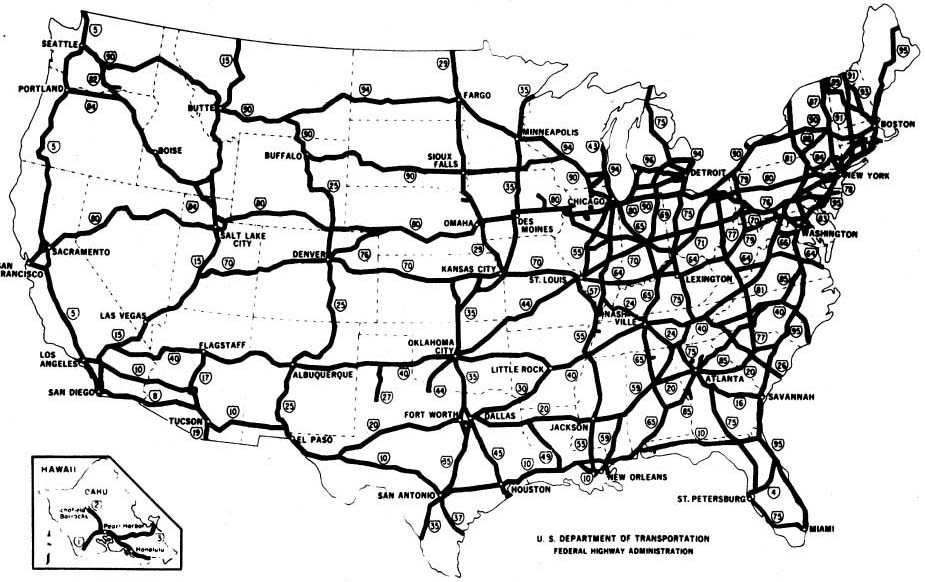
1956 Map of Eisenhower Highway System
Someone should start preparing the eulogy for publicly operated, built, and financed roads.  The era of government grants, shovel-ready projects, and pork-barrel politics is coming to an end, and, like anyone overstaying their welcome, it’s taking much longer than is appropriate to say goodbye.  I believe that the construction of a standardized, integrated 41,000+ (Roth 2010) mile national highway system could only be possible with the massive amount of capital and funding provided by the federal government.   However, with the completion of the highway system near the turn of the century, the era of mega-scale public works projects is waning, replaced, in part, with the bothersome and costly task of adequately maintaining and operating that infrastructure.  In addition to states deferring routine highway maintenance in hopes that the federal government will simply replace it (Semmens 2012), there are issues with lobbyists and special interest groups impractically influencing the funding and revenue streams;  inefficiencies and waste with multi-level government planning; and over-regulated systems that discourage any kind of innovative cost-saving practices (Roth 2010).  In contrast, private entities won’t build a project unless they see a return in it, i.e. unless it makes economic sense, and their relatively smaller size allows for more customized solutions that better represent the needs and behaviors of the users. 

Monday, April 15, 2013

Congestion and Cost

With the understanding that London is slated to increase to nine million people by 2020, or +13% from where it is now, efforts are being made to ensure that their transportation system will be both financially stable and suitably accessible to those in the future.